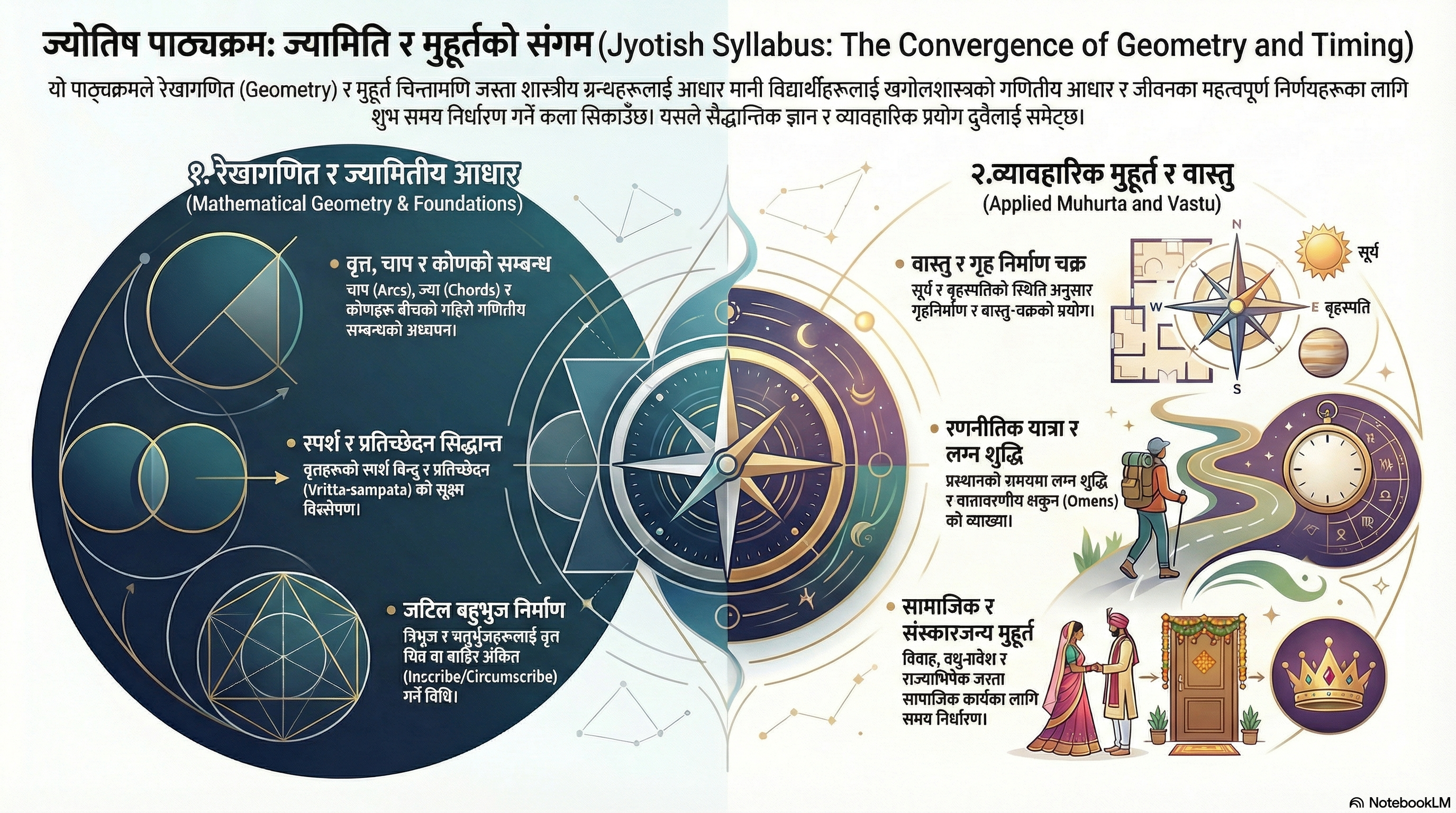
Vedic Astrology, or Jyotish Shastra, is often perceived solely as a mystical art of prediction. However, a deeper look reveals that it is fundamentally a discipline rooted in rigorous spatial reasoning and mathematical precision. The classical curriculum, particularly the study known as Rekhaganitam Muhurtaphalashastram, bridges the gap between abstract mathematical theory and the practical application of predictive sciences.
This discipline views astrology not merely as intuition, but as a science built upon a geometric substratum, where the movements of the celestial sphere are understood through the lens of Euclidean principles.
1. The Geometric Foundation (Rekhaganitam)
Before one can decipher the language of the stars, one must master the language of shapes. The study of Rekhaganita (Geometry)—specifically the properties of the circle (Vrittakshetra)—is considered the "foundational knowledge" (Adharabhuta-jnana) required for constructing horoscopes and calculating planetary positions.
- The Circle of Time: Unlike modern geometry's focus on coordinates, this classical approach emphasizes the relationships between arcs (Chapa), chords (Jya), and angles (Kona). Understanding how angles are subtended at the center versus the circumference is essential for mapping the zodiac.
- Planetary Interactions: The study of tangency and intersection—how circles touch (Sparsha-bindu) and cross (Vritta-sampata)—provides the geometric basis for understanding how celestial bodies visually approach, conjoin, and separate from one another in the sky.
- Cosmic Polygons: Advanced constructions, such as inscribing complex polygons within circles, prepare the astrologer for the intricate spatial divisions used in calculating planetary houses and aspects.
2. The Sociology of Time (Muhurta Shastra)
Once the spatial framework is established, the focus shifts to Muhurta Shastra—the science of selecting auspicious times. Based on the classical text Muhurtachintamani by Ramdaivajna, this module teaches students how to harmonize specific activities with favorable planetary configurations. A close examination reveals that the "core" of this science revolves around three major pillars of human life: domestic transitions, construction, and travel.
A. Domestic Rites and Family Life
The syllabus places a heavy emphasis on the rituals that bind families, particularly those surrounding marriage and the establishment of a household.
- The Bride’s Journey: The coursework covers specific calculations for Vadhu-pravesha (the bride's first entry into her marital home) and Dviragamana (the ritual return or second entry). Students must learn to calculate Nakshatra shuddhi (purification of the lunar mansion) to ensure domestic harmony.
- Sacred Timing: Beyond the social aspect, the syllabus includes the timing for Agnyadhana, the sacred establishment of the ritual fire, underscoring the spiritual dimension of domestic life.
B. Architectural Astrology (Vastu)
A significant portion of the Muhurta curriculum is dedicated to Vastu—the astrological rules governing construction and residence.
- Breaking Ground (Griharambha): Students analyze the influence of the Sun, Jupiter, and Venus to determine the right time for starting construction. This includes specific rituals like Khatarambha (digging the foundation) and Masashuddhi (selecting the pure month).
- The Vastu Chakra: A key technical tool introduced here is the Vastu Chakra, used to align the home with cosmic energies during both construction and the placement of the ceremonial pot (Kalasha).
- Entering the Home (Grihapravesha): The syllabus distinguishes between entering a newly built home versus a renovated or old one (Jirnagriha). Calculations are made to ensure the home brings Dhana-dhanya (wealth and grain) rather than misfortune.
C. Strategic Mobility (Yatra)
Travel is treated as a high-stakes activity. In an era where travel was fraught with danger, determining the right time to leave was a matter of survival and success.
- Lagna Shuddhi: The core task for the astrologer is Lagna Shuddhi—purifying the Ascendant at the time of departure. The syllabus explicitly lists Tyajyalagna—specific Ascendants that must be strictly avoided during travel.
- Omens and Obstacles: Interestingly, the course integrates the study of Shakuna (omens), teaching students to interpret signs in the environment. It also covers technical flaws to avoid, such as Ghatachandra (the Moon in an adverse transit) and Kalapasha (the Noose of Time).
- Royal Movement: Reflecting its classical roots, the syllabus even touches upon Rajabhisheka (coronation) and the timing of royal expeditions, such as travel on Vijayadashami.
3. Analytical Methods in Natal Astrology (Jataka)
Moving from the timing of events to the interpretation of individual destiny, the study of Jataka focuses on the functional nature of planets.
- Planetary Functionalism: A planet is deemed benefic or malefic not based on its inherent nature alone, but on its lordship of Angles (Kendra) and Trines (Trikona).
- Yogas (Combinations): Potent combinations like Rajayoga—specifically the relationship between the lords of the 9th and 10th houses—are studied to understand success and status.
- Longevity: A significant portion is dedicated to identifying critical periods in life through Maraka (killer) planets and divisional charts like Drekkana and Navamsha.
4. The Art of Horary Astrology (Prashna)
The final and perhaps most investigative branch is Prashna Shastra (Horary Astrology), where predictions are made based on the exact moment a question is asked.
- Forensic Astrology: Methods are taught for locating lost or stolen property (Nashta-dravya) and identifying the thief.
- Conflict and Illness: It covers predictions regarding victory or defeat in disputes (Jaya-parajaya) and the prognosis of illness (Rogarta).
- Psychological Divination: The most esoteric aspect involves Mushti-prashna, where the astrologer must divine what the querent is thinking or holding in their hand before they even speak.
Conclusion
The intersection of Geometry and Predictive Astrology reveals a sophisticated system where space and time are inextricably linked. By mastering the geometry of the heavens, the astrologer gains the tools to navigate the sociology of time—removing Doshas (flaws) and aligning human actions with the cosmic order to clear the path for success.