Pashupatinath: The Historical and Spiritual Anchor of the Kathmandu Valley
Discover the profound historical, political, and philosophical significance of Pashupatinath, the guardian deity of Nepal.
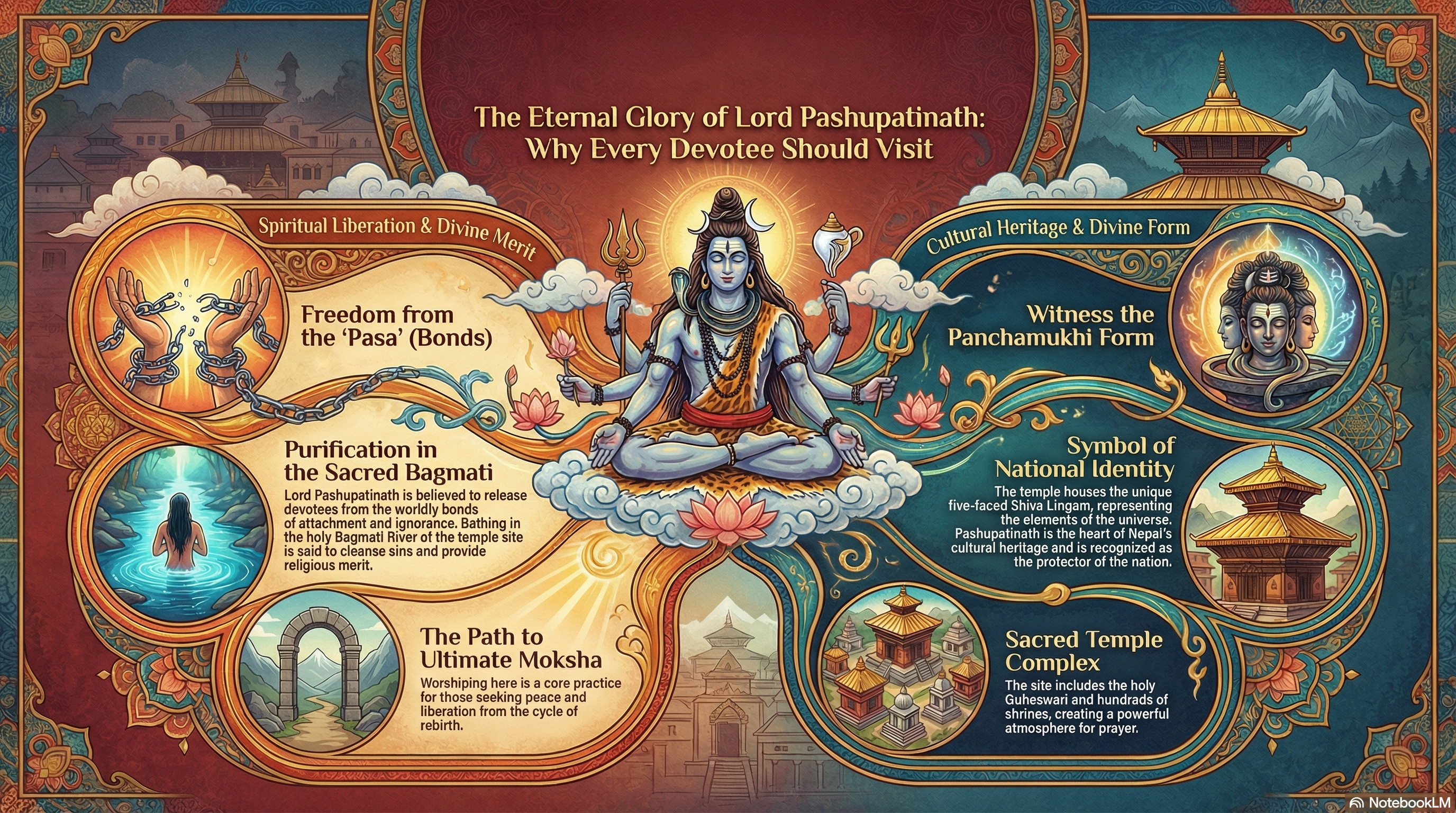
The Pashupatinath Temple complex stands not merely as a place of worship but as a monumental testament to the religious, cultural, and political history of Nepal. Situated on the banks of the Bagmati River, the site represents a continuity of faith that has shaped the identity of the Kathmandu Valley for millennia. Please find below a detailed exploration of its iconography, mythology, and philosophy.
The Antiquity of the Pashupati Kshetra
The region surrounding the temple, known as the Pashupati Kshetra, has historically been a nexus of civilization in the Himalayas.
- The Bagmati River: Often revered as the "Ganga of Nepal," the Bagmati is described in the Himvatkhanda as Shivahasya (the laughter of Shiva), flowing directly from the head of the Shivapuri mountain. It is believed that bathing in or even drinking its waters cleanses sins accumulated over lifetimes, offering a sanctity equivalent to or surpassing other major sacred rivers.
- Mrigasthali (The Deer Park): Located across the river, this forest is where Shiva is said to have assumed the form of a deer (Mriga) to enjoy the tranquility of nature with Parvati. It is traditionally believed that those who pass away in this sacred vicinity are granted liberation from rebirth, attaining Shivapada.
- Guhyeshwari: The nearby Guhyeshwari shrine is a significant Shakti Peetha. It represents the feminine power (Shakti) essential to Shiva. The philosophy dictates that without Shakti, Shiva is merely "Shava" (a corpse); they are inseparable, like fire and its heat.
The Five Divine Faces of Pashupatinath (Panchamukha)
A significant portion of the philosophical significance of the temple is dedicated to explaining the Panchamukha (five-faced) form of the Shiva Linga found at the Pashupatinath temple. Each face looks in a specific direction and embodies distinct cosmic elements, senses, and divine aspects.
1. Sadyojata (The West Face)
The face looking West is known as Sadyojata. It represents the element of Earth (Prithvi). In the context of the human body and senses, this face governs the sense of smell (Gandha) and the organ of generation. It is associated with the color white. The text describes this face as the embodiment of the creative force that represents the gross material world.
2. Vamadeva (The North Face)
The face looking North is called Vamadeva. It represents the element of Water (Jal). It governs the sense of taste (Rasa) and the hands (organs of action). This face is associated with the color red. Vamadeva represents preservation and the fluidity of life. The text notes that water is essential for life, connecting this face to the sustenance of the world.
3. Aghora (The South Face)
The South-facing face is Aghora. It represents the element of Fire (Tejas or Agni). It governs the sense of sight (Rupa) and the feet (organs of movement). This face is associated with the color yellow. "Aghora" literally means "not terrifying" or "gentle," yet it is often associated with the fierce, transformative aspect of Shiva that destroys ignorance. As fire illuminates form, this face is connected to knowledge and perception.
4. Tatpurusha (The East Face)
The East-facing face is Tatpurusha. It represents the element of Air (Vayu). It governs the sense of touch (Sparsha) and the skin. This face is associated with the color black (or dark blue). Air is the breath of life (Prana), making this face central to the vital force that animates living beings. It represents the obscuring power of Maya (illusion), which Shiva can remove.
5. Ishana (The Upward Face)
The fifth face, which looks upward toward the zenith, is called Ishana. It represents the element of Ether or Sky (Akash). It governs the sense of hearing (Shabda) and the power of speech. This face is described as "crystal clear" or colorless, representing pure consciousness. It is the master of all knowledge (Vidyeshwara) and the highest aspect of Shiva accessible to human understanding. It represents the space in which all other elements exist.
Together, these five faces constitute the "Sadasiva" form—the eternal Shiva who pervades the entire universe through these five elements (Earth, Water, Fire, Air, Ether).
The Origin of the Shiva Linga
To illustrate the supremacy of Lord Shiva, the temple lore retells the Puranic story of the Lingodbhava (Emergence of the Linga):
- The Dispute: Brahma (the Creator) and Vishnu (the Preserver) once disputed who was supreme.
- The Manifestation: Suddenly, a colossal, beginningless and endless pillar of fire (Jyotirlinga) appeared between them, blazing with the brilliance of a thousand suns.
- The Test: Vishnu took the form of a boar (Varaha) to dig for the base, while Brahma became a swan (Hamsa) to fly to the summit. After searching for thousands of years without success, they admitted defeat.
- The Revelation: Shiva emerged from the pillar, revealing he is the origin of both, the Aja (unborn), and the source of the cosmic syllable A-U-M. This established the Linga as the symbol of the Formless Infinite.
Philosophical Legacy: Bondage and Liberation
The very name Pashupatinath encapsulates the core of Shaiva Siddhanta and Kashmir Shaivism philosophy regarding the soul's journey:
- Pashu (The Living Being): Refers to the individual soul (Jiva), which is essentially Shiva but has forgotten its true nature.
- Pasha (The Bondage): The soul is tied by three impurities (Malas) that cause ignorance:
- Anava Mala: The primal ignorance of feeling small and separate.
- Karma Mala: The binding force of good and bad actions leading to rebirth.
- Mayiya Mala: The delusion caused by the material world.
- Pati (The Lord): Pashupatinath is the Master who liberates the soul by "cutting the noose" of these impurities.
Liberation (Moksha): True freedom is achieved when the soul realizes its identity with Shiva. Through the grace of the Guru and the removal of ignorance, the soul recognizes "Shivoham" (I am Shiva), merging back into the eternal witness.
Socio-Political Significance
Pashupatinath has long been regarded as the "National Guardian." Historically, the rulers of Nepal—from the Licchavi period through the Malla and Shah dynasties—did not rule as absolute owners of the land but as stewards of Pashupatinath. This relationship provided a framework where spiritual and temporal powers were intertwined, designating Nepal as a Devabhumi (Land of Gods) and Tapobhumi (Land of Austerity).
Conclusion
Today, Pashupatinath remains a living heritage site. It is not just a monument but a cosmic center where the human soul can untie the knots of ignorance. Through the symbolism of the five faces, the narrative of the infinite pillar, and the sacred geography of power, it invites every seeker to move from external worship to internal realization.
Prepared by Nepal Jyotish Team.