Lunar Eclipse (Chandra Grahan)
Why the Earth’s shadow falls on the Moon, why it turns red, and the three types of Chandra Grahan.
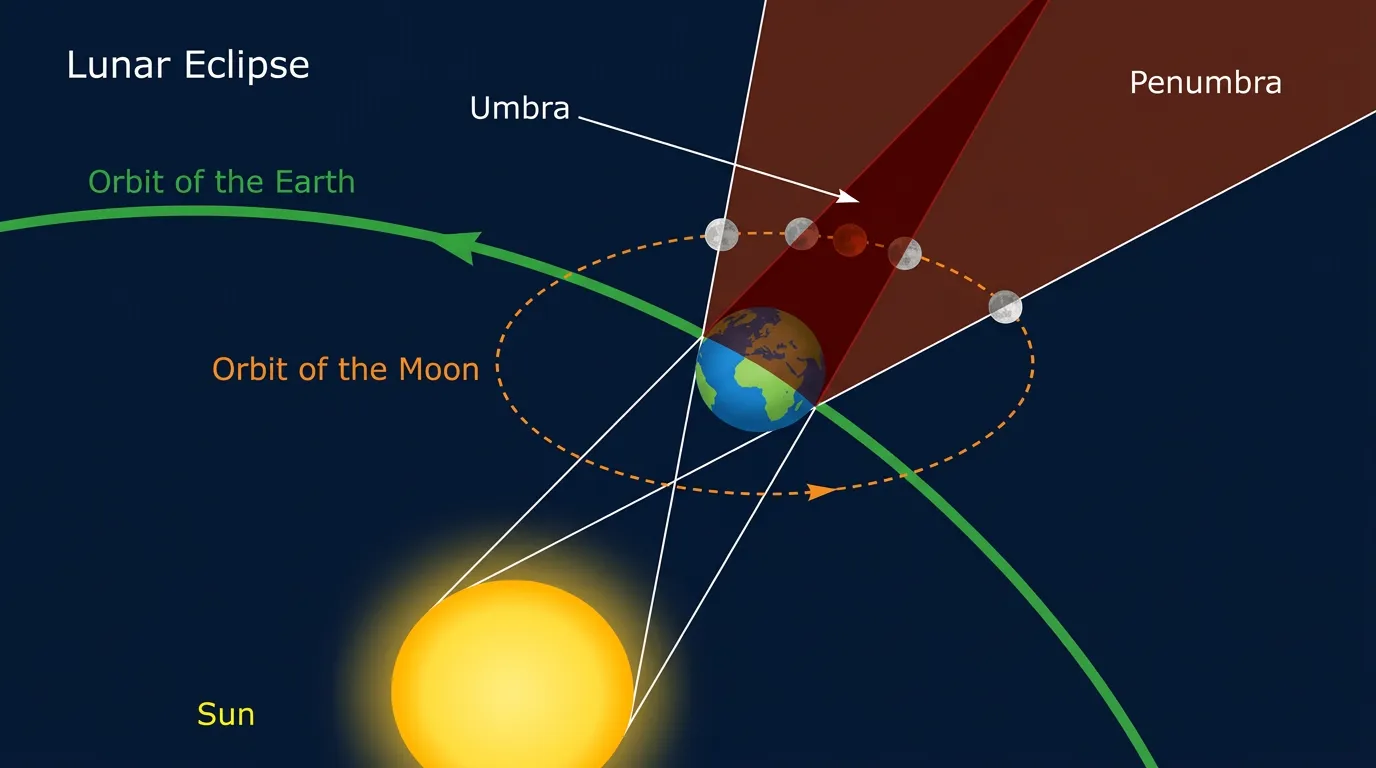
A lunar eclipse is the planetary phenomenon in which the Earth’s shadow falls on the Moon.
A lunar eclipse always occurs on a Full Moon day, known as Purnima (or Pournami) in the Hindu calendar.
Lunar Eclipse Dates & Times
Every Chandra Grahan for the year with exact times and visibility from your country.
OpenSutak — Eclipse Rules
What to avoid in the 9 hours before a lunar eclipse, and the rituals to follow after it ends.
Open- Happens on
- Full Moon (Purnima)
- Lunar eclipses per year
- 0 to 3
- Totality lasts
- 1–2 hours
- Start to end
- 4–6 hours
- Naked-eye viewing
- Safe
Why the Moon Turns Red
During a lunar eclipse, the Earth blocks sunlight from reaching the Moon directly. However, sunlight refracted through the Earth’s atmosphere still reaches the Moon, which is why it remains visible rather than disappearing entirely — and why it takes on a reddish glow during the eclipse.
Umbra and Penumbra
The Earth’s shadow that falls on the Moon consists of two regions: the umbra and the penumbra. This is true of all planetary shadows due to basic principles of physics. The umbra is completely dark since no sunlight reaches it, while the penumbra is only partially dark, as some sunlight still reaches that region.
Types of Lunar Eclipse
- Total Lunar Eclipse (Khagras)
- The Moon passes completely into the umbra — the whole Moon sits inside the Earth’s dark shadow.
- Partial Lunar Eclipse (Khandagras)
- The Moon passes only partly through the umbra — one part of the Moon stays dark while the rest stays lit.
- Penumbral Eclipse (Upachhaya)
- The Moon passes only through the penumbra without touching the umbra at all. Penumbral eclipses are considered minor and often go unnoticed, since they aren’t visible to the naked eye — the Hindu calendar doesn’t list them at all.
Stages of a Total Lunar Eclipse
A Total Lunar Eclipse typically progresses in stages: it begins with a penumbral phase, moves into a partial umbral phase, and then reaches totality. The Moon remains in total eclipse for a while before reversing through the same stages — partial umbral, then penumbral — until the eclipse ends completely.
Why the Same Eclipse Looks Different Elsewhere
Interestingly, the same eclipse can appear differently depending on location. At certain places, a Total or Partial Lunar Eclipse may be visible only as a penumbral eclipse — for instance, if moonrise happens after the Moon has already moved out of the umbra and into the penumbra, or if moonset occurs just before the Moon enters the umbra. Similarly, a Total Lunar Eclipse might appear as only a Partial Lunar Eclipse at some locations for the same reason.
How Often and How Long?
There can be anywhere from 0 to 3 lunar eclipses in a given year. The total phase of an eclipse typically lasts one to two hours, while the full eclipse — from the start of the penumbral phase to its end — lasts about four to six hours. Roughly speaking, a lunar eclipse is about equally likely to be total, partial (umbral), or penumbral.
Is It Safe to Watch?
It is scientifically safe to view a lunar eclipse with the naked eye during either its partial or total phase.