Adhik MasPanchangMatsyavatarHindu AstronomyMalmasNepali CultureChandragiri
Adhik Mas in Hindu Panchang: Astronomical Science, Nepali Traditions, and the Legacy of Matsyayanarayan
A comprehensive scientific and spiritual guide to Adhik Mas (Malmas / Purushottama Mas), its mathematical calculation in the Nepali calendar, and the cultural and ecological significance of the Matsyayanarayan Temple in Kathmandu.
N
Nepal Jyotish Team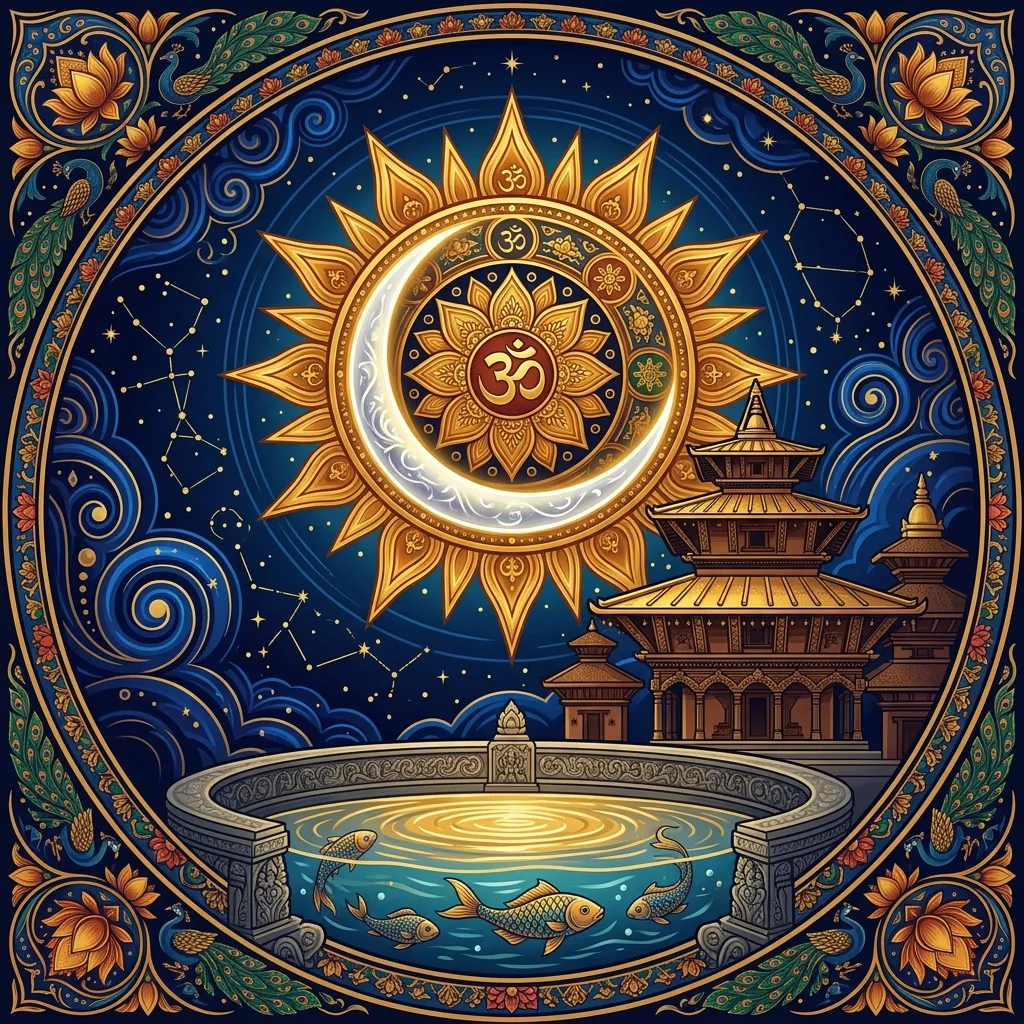
The concept of Adhik Mas (also known as Malmas or Purushottama Mas) in the Hindu calendar and timekeeping system (Panchang) is a brilliant manifestation of celestial mechanics, mathematical precision, and cultural heritage. For centuries, traditional Nepali astrologers and scholars have integrated astronomical calculations with spiritual life, showing that science and faith are two sides of the same coin in the Himalayan region.
This analytical study explores the mathematical scientific basis of Adhik Mas, its spiritual transition, the cultural rules surrounding it, and the national significance of the Matsyayanarayan Temple in Matsyagaon, Kathmandu—the only temple dedicated to Lord Vishnu’s first incarnation in Nepal.
1. The Astronomical Science of Adhik Mas
At its core, the Hindu calendar is luni-solar, meaning it dynamically harmonizes the movement of both the Sun and the Moon. To keep the calendar aligned with seasonal realities (solstices, equinoxes, and harvests), ancient astronomers devised a corrective mathematical algorithm.
The Two Timekeeping Systems
- Solar Year (): Based on the earth’s revolution around the sun (specifically, the Sun entering the 12 zodiac signs, or Sankranti). Its precise duration is:
- Lunar Year (): Based on 12 lunar cycles (from new moon to new moon, consisting of 360 Tithis). Its duration is:
In traditional Nepali Panchang practice, the solar year is simplified to 365 days, and the lunar year is approximated as 355 days.
The Mathematical Discrepancy and Correction
The difference between the solar and lunar year is calculated as:
Without adjustment, this annual 11-day gap would accumulate. In three years, the lunar calendar would slide backward by approximately 33 days relative to the seasons. Consequently, festivals like Dashain (traditionally celebrated in autumn) would eventually migrate into summer and spring, disrupting agricultural and ritual cycles.
To prevent this seasonal drift, the astronomical corrective cycle rule is applied:
Every 32 months, 16 days, and 4 gharis (approximately 2.7 years), an additional month is inserted into the lunar calendar. This intercalary month is what we call Adhik Mas (literally, the "Extra Month").
| Calendar Parameter | Astronomical Basis | Traditional Duration | Exact Scientific Duration | Adjustment Method |
|---|---|---|---|---|
| Solar Calendar | Solar Zodiac Entry (Sankranti) | 365 Days | 365.2422 Days | Stable base system |
| Lunar Calendar | Lunar Phase Cycle (Tithi) | 355 Days | 354.3670 Days | Intercalation of Adhik Mas every ~3 years |
2. Why is it called Malmas and Purushottama Mas?
Every standard lunar month contains a Sankranti—the specific transit where the Sun moves from one zodiac sign (Rashi) to the next. However, because the Moon’s cycle is faster, the intercalary Adhik Mas occurs during a period where no solar transit (Sankranti) takes place.
Because it lacks a solar transit, the month was historically deemed "impure" and termed Malmas (the "soiled" or "unclean" month). It was neglected for traditional auspicious ceremonies because no energy-giving solar transit ruled it.
The Mythological Transformation
According to Puranic literature, the personified deity of the neglected Malmas wept before Lord Vishnu, lamenting its low status and rejection by all gods. Moved by compassion, Lord Vishnu blessed the month:
"I bestow upon you My ultimate name, 'Purushottama' (the Supreme Being). I shall be the ruling deity of this month, elevating its spiritual potential far beyond standard months."
Thus, Malmas was transformed into Purushottama Mas. While it remains unsuited for physical or material achievements, it is considered the most spiritually potent month in the Hindu calendar for devotion, meditation, and self-purification.
ॐ नमो भगवते वासुदेवाय ॥
3. Prescriptions and Prohibitions: The Shastric Code
In Nepal, Adhik Mas is treated as a highly active spiritual transition. While material pursuits are temporarily suspended, introspective and purification rituals are highly encouraged.
Forbidden Activities (Varjit Karma)
According to the Nirnayasindhu and Dharmasindhu, Kamya Karma—rituals performed with the expectation of material reward or social gain—are strictly prohibited:
| Prohibited Ritual | Shastric Rationale |
|---|---|
| Deva Pratishtha | Consecration of new temple deities or idols is paused. |
| Griharambha & Vastu Shanti | Initiating construction on new homes or conducting housewarming rituals is forbidden. |
| Vivaha (Marriage) & Upanayana (Upanayan) | Entering new life stages, such as marriage or sacred thread ceremonies, is suspended. |
| New Pilgrimages | Launching new pilgrimage journeys to shrines never visited before is prohibited. |
| Vrata Udyapan | Starting a brand new fast (Vrata) or completing/closing an ongoing fast is disallowed. |
Recommended Spiritual Practices (Vihit Karma)
Conversely, spiritual exercises aimed at purification, self-control, and charity yield multi-fold rewards during this month:
- Amla Snan: Bathing in cool water early in the morning and using paste made of Indian gooseberry (Amla) under an Amla tree is believed to cleanse cellular toxins and mental debris.
- Mauna Bhojan: Observing complete silence (Mauna) while eating a single daily vegetarian meal (Ekabhukta). This cleanses speech-related errors and fosters mindfulness.
- Akhanda Deep Daan: Lighting ghee or oil lamps daily before Lord Vishnu. At the end of the month, the lamps are donated to scholars or priests.
- Gau Seva: Feeding Puranpoli (sweet flatbreads) to cows, representing the honoring of all celestial energies.
4. The Family Dynamic: 33 Apoop (Anarasa) Donation
A beautiful custom unique to Nepali culture during Adhik Mas is the honoring of daughters and sons-in-law, who are treated as the living embodiments of Lakshmi and Narayana.
Parents invite their daughters and sons-in-law home, wash their feet, and offer them a feast. The centerpiece of this ritual is the donation of 33 Apoop (traditionally prepared mesh-structured rice-flour and ghee cakes called Anarasa), placed on a copper or silver plate with a bronze oil lamp in the center.
The Mathematical and Spiritual Breakdown of 33
The number 33 represents the 33 Koti (types) of Deities in the Vedic pantheon. Donating 33 Anarasas satisfies these energies and brings cosmic balance to the family. Astrologically, the 33 items are distributed to resolve specific karmic discrepancies:
| Anarasa Count | Intended Recipient / Karmic Purpose | Karmic Resolution |
|---|---|---|
| 1 to 30 | Dedicated to the 30 days of the lunar month. | Forgives minor unconscious daily errors. |
| 31st Anarasa | Atonement for eating at a daughter's or niece's home. | Resolves the spiritual debt of consuming a daughter's food. |
| 32nd Anarasa | Atonement for eating at a Guru's or Priest's home. | Prevents the depletion of personal spiritual energy (Tejas). |
| 33rd Anarasa | Atonement for consuming food from a home under ritual impurity (Sutak/Patak). | Neutralizes spiritual contamination from births or deaths. |
The Mystery of the Mesh Holes (Chhidra)
During deep-frying in ghee, a perfect Anarasa develops thousands of tiny porous holes (Chhidra) on its surface. According to the Shiva Purana and Padma Purana:
"For every single pore (hole) that forms on the surface of the fried Apoop, the ancestors (Pitrus) of the donor are spared a thousand years of lower-world suffering, gaining direct passage to Vishnuloka."
5. The Epicenter of Adhik Mas: Matsyayanarayan Temple
In Nepal, the onset of Adhik Mas immediately directs attention to Matsyagaon (मच्छेगाउँ), located in Ward 9 of the Chandragiri Municipality in the Kathmandu Valley. Here lies the historical and sacred pool temple of Matsyayanarayan, the only temple in Nepal dedicated to Lord Vishnu's first avatar—the Fish Incarnation.
       [Satyayuga: King Satyavrata performs libation in the river]
                                  │
                                  ▼
      [Small fish caught in his hands -> Astounding overnight growth]
                                  │
                                  ▼
    [Vishnu reveals His giant Matsya form -> Warns of impending deluge]
                                  │
                                  ▼
     [Great Flood: Boat tied to Matsya's single horn using Vasuki Serpent]
                                  │
                                  ▼
    [Slaying of Hayagriva (Shankhasur) -> Retrieval of Vedas for Brahma]
The Legends of Matsyagaon
- The Satyayuga Deluge: According to the Matsya Purana, King Satyavrata (Manu) was performing morning prayers by a river when a small fish entered his hands. The fish grew exponentially, eventually filling lakes and requiring relocation to the ocean. Vishnu then revealed Himself, warning of a global flood. During the deluge, Vishnu in His giant Fish form anchored Manu's ark to His single horn using the serpent king Vasuki, preserving the seeds of life and recovering the stolen Vedas from the demon Hayagriva. Locals believe this sacred temple pond is where the original well dug by Manu was located.
- The Dvaparayuga Conjunction: Another legend tells of Lord Krishna visiting the forest of Matsyagaon with cowherd boys (Gwalas). Krishna suddenly disappeared into the water pond. It was Purushottama Mas, and the boys spent a month crying and praying in devotion. Satisfied, Lord Vishnu emerged from the pond in His Matsya form to grant them a vision, cementing the custom of holding a month-long festival here during Adhik Mas.
Archaeological and Sacred Topography
Dating back to the Licchavi and Gopala eras, the temple complex features three main ponds:
- Suvarnakunda (Golden Pond): Surrounds the main central temple housing the stone idol of Matsyayanarayan, depicted emerging from the mouth of a massive fish.
- Matsyakunda (Fish Pond): The large front pool where hundreds of sacred fish swim freely.
- Nagakunda: The protective serpent pool located directly behind the main temple structure.
Every three years, the month-long Matsyayanarayan Mela draws millions of pilgrims from Nepal and India. The entire valley joins in prayer, chanting, and night-long lighting of lamps.
6. The Ecological Challenge: Eutrophication in Matsyakunda
With millions of pilgrims visiting during the month-long Mela, the sacred ponds face severe environmental pressure. In recent years, local committees have struggled with a recurring issue: mass fish die-offs immediately after the festival concludes.
The Root Cause: Eutrophication
Devotees, out of deep faith, throw large quantities of Apoop (Anarasa), sweet rice flour, grains, and oily foods directly into the water as offerings to the sacred fish. Over the month, these organic materials decompose.
The decomposition process consumes dissolved oxygen in the water and triggers rapid algal blooms—a classic ecological phenomenon known as Eutrophication.
Modern Sustainable Solutions
To preserve both religious devotion and environmental health, the local ward office and temple management committee have initiated modern conservation efforts:
- Aerator Installation: Mechanical paddle-wheel aerators have been installed in Matsyakunda to physically pump oxygen back into the water.
- Food Restrictions: Devotees are now encouraged to place their offerings on designated floating platforms or in dry collection bins, rather than directly polluting the open water.
- Bio-filtration Systems: Natural wetlands and gravel filtration systems are being designed around the ponds to cycle the water and maintain a healthy ecosystem.
7. Relationship with Newari Festivals and the Nepali Calendar
The presence of Adhik Mas shifts the entire lunar cycle of Nepal by one month, directly impacting the schedule of regional festivals.
Traditional Newari festivals in the Kathmandu Valley, such as Yenya (Indra Jatra), Chobahar Lokeshwar Snan, and Janabahal's White Machindranath Rath Yatra, are calculated based on lunar phases (Tithis). In years containing an Adhik Mas, scholars and calendar committees (Panchanga Nirnayak Samiti) perform meticulous calculations to adjust the Newari months like Gunla and Choula, ensuring that festivals do not clash with the prohibited Malmas period.
Consequently, during an Adhik Mas year, major Nepali festivals like Dashain and Tihar are delayed by almost a month, shifting from September/October to late October/November.
Conclusion: Balancing Space, Time, and Nature
Adhik Mas is much more than a mathematical adjustment on a calendar page. It is a brilliant ancient synchronization of cosmic time, an invitation to turn our gaze inward toward spiritual purity, and a beautiful cultural celebration that strengthens family bonds.
As we look toward the upcoming Jyeshtha Adhik Mas of 2026 (Jyeshtha 17 to Ashar 15, 2083 B.S.), visiting the serene ponds of Matsyayanarayan reminds us of our duty to protect our sacred ecosystems. By embracing sustainable devotion, we ensure that both our ancient spiritual heritage and the natural beauty of Nepal’s sacred spaces continue to thrive for generations to come.