ShrawanLord ShivaShrawan SomvarBol BamWomen and FaithHindu TraditionsNepali CultureSaubhagya
The Verdant Devotion: A Deep Look at Women’s Celebration of Shrawan and Lord Shiva
Discover the profound spiritual, cultural, and seasonal significance of Shrawan—the holiest month of the Nepali Hindu calendar—where women’s vibrant green attire, fasting, and pilgrimage honor Lord Shiva and the life-giving monsoon.
N
Nepal Jyotish TeamFor Hindu women in Nepal and across South Asia, the month of Shrawan (श्रावण)—the fourth month of the Nepali Hindu calendar—is not merely a period on the calendar but a vibrant tapestry of faith, color, and cultural identity. As the holiest month of the year, it transforms the landscape into a sea of green, mirroring both the lush monsoon nature and the spiritual fervor dedicated to Lord Shiva (Mahadev).
Shrawan in the Hindu Calendar
Shrawan (also spelled Shravan or Sawan) typically falls between mid-July and mid-August in the Gregorian calendar. In the Nepali Bikram Sambat calendar, Shrawan is the fourth month, marking the heart of the monsoon season. The month is considered so sacred that every day of Shrawan holds religious significance, but Mondays (Somvar) are especially venerated as Shrawan Somvar—the most auspicious days for Shiva worship.
The Legend of Eternal Devotion
The deep connection between Shrawan and Lord Shiva is rooted in ancient Vedic and Puranic lore. Two major legends explain why this month is held in such high regard:
Parvati's Austere Penance
According to legend, Parvati—the daughter of King Himachal (the personification of the Himalayas) and Queen Menka—desired to marry Lord Shiva, the supreme ascetic. To win his heart and prove her unwavering devotion, she undertook a rigorous fast and penance that lasted the entire month of Shrawan. She renounced all comforts, meditated in the harsh wilderness, and subsisted on minimal food. Her steadfast tapasya (austerity) eventually moved Lord Shiva, and he accepted her as his consort.
This story established a timeless precedent: unmarried women who fast during Shrawan with sincere devotion may be blessed with a virtuous and suitable husband, just as Parvati was united with Mahadev. For married women, the fast is a prayer for the long life, health, and prosperity of their husbands—a tradition known as Saubhagya Vrat.
Samudra Manthan and the Halahal Poison
Another significant reason for the month's sacredness is the story of Samudra Manthan (the churning of the cosmic ocean). The Devas (gods) and Asuras (demons) churned the Kshira Sagara (ocean of milk) to obtain Amrit (the nectar of immortality). However, before the nectar emerged, a deadly poison called Halahal (Kalakut) surfaced, threatening to destroy all of creation.
Neither the Devas nor the Asuras could withstand the poison. In their desperation, they prayed to Lord Shiva. Moved by compassion, Shiva gathered the poison in his palm and swallowed it. Goddess Parvati, alarmed, clasped his throat to prevent the poison from descending into his body. The Halahal remained lodged in his throat, turning it blue—hence the name Neelkanth (the Blue-Throated One).
To soothe the burning sensation caused by the poison, the Devas and devotees began the tradition of offering cool water, milk, and Belpatra (wood apple leaves) to the Shiva Linga. This practice remains central to Shrawan rituals to this day: devotees perform Jalabhishek—the ceremonial pouring of water and milk over the Linga—accompanied by the offering of Belpatra, Dhaturo (thorn apple), and other sacred items believed to have a cooling effect.
The Symbolism of Green and Saubhagya
During Shrawan, the color green (Hariyo) becomes a powerful and ubiquitous symbol of growth, fertility, and marital blessings (Saubhagya) . The monsoon transforms the hills and valleys of Nepal into a verdant paradise, and women mirror this renewal through their attire. The traditional color ensemble includes red, yellow, and primarily green—each carrying its own significance:
Green Bangles (Chura)
Women wear green glass bangles on their wrists throughout the month. These bangles are far more than decorative accessories; they symbolize a prayer for a year of prosperity, growth, and fulfillment of heartfelt desires. The chime of glass bangles is considered auspicious, and breaking them during Shrawan is traditionally seen as inauspicious. In many communities, new green bangles are worn each Monday after the Shiva Puja.
Pote (Green Bead Necklaces)
Married women wear strings of green glass beads called Pote around their necks. In Nepali Hindu culture, Pote is one of the most visible markers of a married woman's status—equivalent to the Mangalsutra in other South Asian traditions. Wearing green Pote during Shrawan carries a dual prayer: for the long and healthy life of the husband and for the enduring strength of the marital bond. The green color connects this personal prayer to the broader fertility of the earth blessed by monsoon rains.
Mehendi (Henna)
The application of intricate Mehendi (henna) designs on the palms and feet is a hallmark of Shrawan celebrations. Beyond its aesthetic beauty and its association with festivity, Mehendi serves an important scientific and medicinal purpose. Henna possesses natural cooling properties that help regulate the body's temperature during the humid and sweltering monsoon season. The darker the henna stain, the stronger the belief in the husband's love and the mother-in-law's affection.
Additionally, henna has antifungal and antimicrobial properties, making it particularly beneficial during the damp monsoon when skin infections are more prevalent.
Rituals of Faith: Fasting and Pilgrimage
Shrawan Somvar (Monday Fasts)
The Mondays of Shrawan are the crown jewels of the month. On these days, women observe the following practices:
- Pre-dawn Purification: Women rise before sunrise and take a purifying bath, often adding a few drops of Ganga Jal (holy water) to the bathing water.
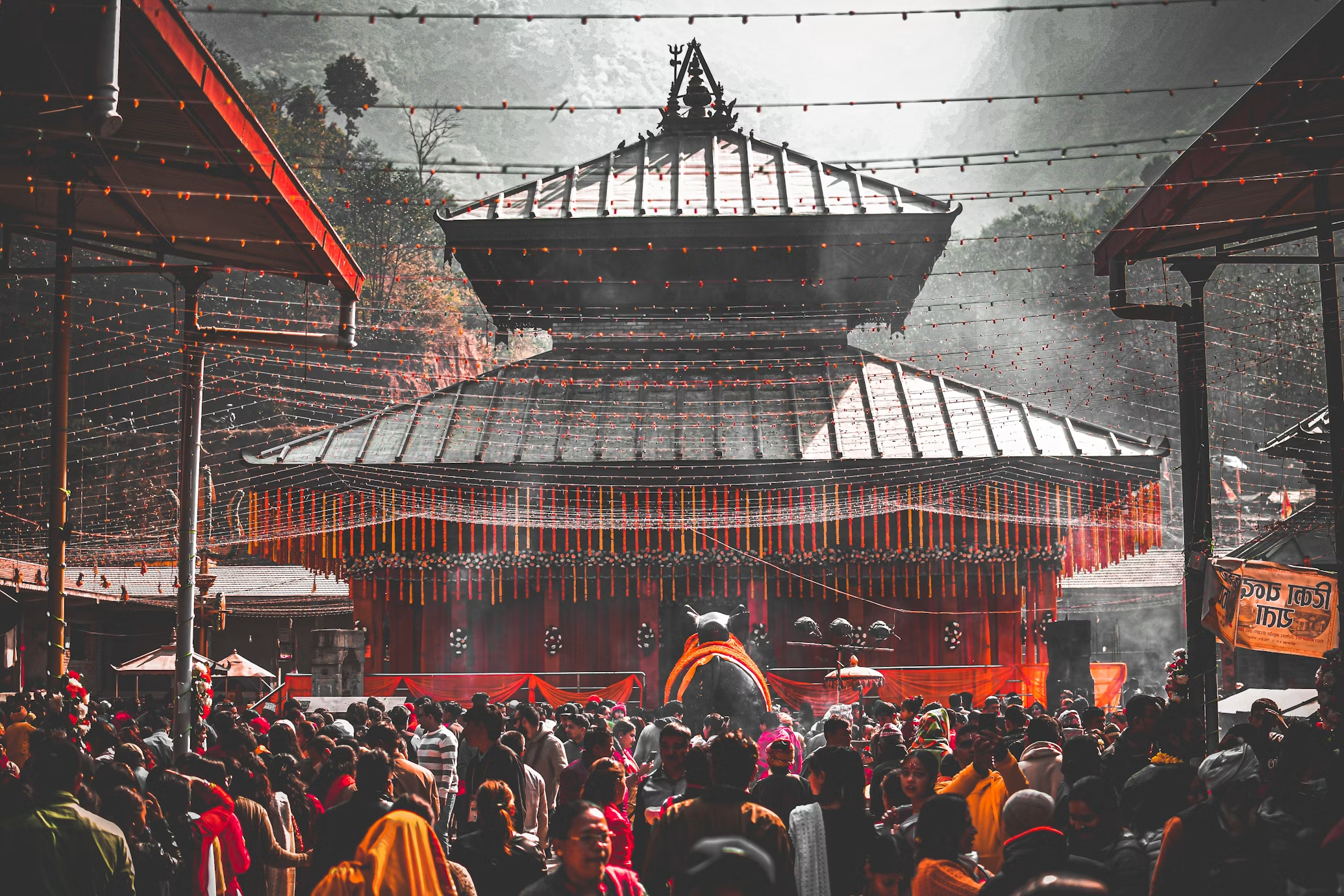
- Temple Visits: Devotees visit Shiva temples in their vicinity. In Kathmandu, the Pashupatinath Temple—one of the holiest Shiva shrines in the world—sees an extraordinary surge of devotees during Shrawan Mondays. The queues stretch for kilometers as thousands wait to offer their prayers.
- Fasting (Vrat): Many women observe a strict Nirjala Vrat (fast even without water) or a Phalahar Vrat (surviving on fruits and milk alone). The fast is broken only after the evening Puja and the sighting of the moon.
- Shiva Puja: The worship includes Jalabhishek (pouring water/milk), offering Belpatra (three-leaf clusters of the wood apple tree, said to represent the three eyes of Shiva), Dhaturo, Chandan (sandalwood paste), and lighting Deepak (oil lamps).
- Shiva Purana Recitation: Listening to or reciting passages from the Shiva Purana or the Shiva Mahimna Stotram is considered especially meritorious during this month.
The Bol Bam Pilgrimage
A more rigorous and visually spectacular form of devotion is the Bol Bam pilgrimage, observed primarily in Nepal and parts of northern India. The word "Bol Bam" translates to "Say Shiva" or "Chant Bam (Shiva)."
- The Journey: Thousands of devotees—men and women alike—undertake a barefoot pilgrimage to fetch holy water from a sacred river or stream.
- The Kanwar: Devotees carry a decorated pole called a Kanwar on their shoulders, with small pots of holy water suspended from either end of the pole. The water must not touch the ground until it is poured over the Shiva Linga at the destination temple.
- The Attire: Pilgrims typically dress in saffron (Bhagwa) robes, symbolizing renunciation and spiritual pursuit.
- The Chant: Throughout the arduous journey—which can span many kilometers over several days—devotees continuously chant "Bol Bam" or "Har Har Mahadev," maintaining a trance-like spiritual focus.
- The Offering: Upon reaching the Shiva temple, the holy water is poured over the Linga with prayers for health, wealth, spiritual happiness, and the fulfillment of wishes.
The Bol Bam pilgrimage is a powerful expression of faith that transcends age, social status, and gender, though it requires significant physical endurance.
Connection to Nature, Agriculture, and Health
The celebration of Shrawan is deeply intertwined with Nepal's monsoon cycle and agrarian rhythm. Far from being an arbitrary religious observance, the month's customs reflect an ancient, intuitive understanding of the relationship between the human body, the seasons, and the agricultural calendar.
The Agrarian Cycle
Shrawan arrives just as the monsoon is at its peak. By this time, the strenuous work of paddy planting (Ropai) —which takes place in Asar (June–July)—is largely complete. After weeks of backbreaking labor in waterlogged fields, the farming community enters a period of relative rest and rejuvenation.
Dakshinayan: The Sun's Southward Journey
Astronomically, Shrawan coincides with Dakshinayan—the six-month period when the Sun begins its apparent southward journey after the summer solstice. In Hindu cosmology, Dakshinayan is considered the "night of the Devas," a period more suited to inward spiritual practice, devotion, and worship. The emphasis on fasting, prayer, and pilgrimage during Shrawan is consistent with this cosmic orientation.
Dietary Wisdom
The customs of Shrawan reflect sophisticated dietary wisdom:
- Kheer (Rice Pudding): Around the 15th of Shrawan, families traditionally prepare and consume Kheer—a nourishing sweet dish made of rice, milk, and sugar. This practice replenishes the energy depleted during the physically demanding paddy planting season.
- Sattvic Diet: Many devotees adopt a Sattvic (pure) diet throughout Shrawan, avoiding meat, eggs, onion, garlic, and heavy or spicy foods. The rationale is both spiritual (purity supports devotional practice) and physiological: the digestive system is believed to be more sensitive during the humid monsoon, making light, easily digestible food more appropriate.
- Fasting as Detoxification: The periodic fasting of Shrawan Mondays can be understood as a gentle detoxification practice, giving the digestive system a rest when waterborne illnesses and digestive issues are more common.
Shrawan Sankranti and Luto Phalne
The month begins with Shrawan Sankranti (the first day of Shrawan), which includes the unique ritual of "Luto Phalne" (warding off scabies/skin diseases). In this practice:
- Medicinal plants such as Titepati (mugwort), Bhalayo, and other herbs with known antiseptic and insect-repellent properties are gathered and burned.
- Family members symbolically throw pieces of these plants behind them while reciting mantras.
- The ritual is both symbolic (warding off disease for the coming year) and practical: the smoke from these plants serves as a natural insecticide and antimicrobial agent, helping to prevent skin infections that are common after prolonged work in muddy, waterlogged fields.
The Broader Cultural Canvas
Shrawan in Music and Folklore
The month of Shrawan occupies a prominent place in Nepali folk music, literature, and popular culture. Countless folk songs reference Shrawan—the swaying green paddy fields, the longing of separated lovers, the steady rhythm of monsoon rain, and the devotion-filled temple visits. The melodious notes of the Madal and the Sarangi often accompany Shrawan songs that capture both the romance and the melancholy of the rainy season.
Community Bonding
Shrawan fosters strong community bonds. Women often gather in groups to visit temples together, share the preparation of fasting foods, apply Mehendi to each other's hands, and sing devotional Bhajans. These gatherings serve as important spaces for intergenerational connection—grandmothers, mothers, and daughters participate together, ensuring the transmission of ritual knowledge, folk songs, and cultural values.
Inclusivity of Devotion
While Shrawan is particularly associated with women's devotion, the month's observances are not exclusive. Men also participate in Monday fasts, Bol Bam pilgrimages, and Shiva worship. The month serves as a great equalizer: at the Pashupatinath temple and other shrines, devotees from all castes, economic backgrounds, and regions stand together in shared devotion.
The Philosophical Essence
At its heart, the celebration of Shrawan represents the union of Prakriti and Purusha—the feminine creative energy of nature and the masculine principle of pure consciousness. The verdant monsoon landscape (Prakriti) and the ascetic Lord Shiva (Purusha) come together in a month that celebrates both fertility and renunciation, both the material and the transcendent.
Women's vibrant attire—the green bangles, the Pote, the Mehendi—is not mere adornment. It is a living, breathing prayer. Each green bangle is a wish; each bead of the Pote is a blessing; each henna pattern is a silent mantra. Through their disciplined fasts, their colorful presence, and their joyous community celebrations, the women of Nepal and beyond keep alive a tradition that honors the cosmic dance between Shiva and Shakti, between the life-giving monsoon and the spiritual aspirant, between the earth and the divine.
Prepared by Nepal Jyotish Team.