Bikram SambatCalendarCultureHistoryAstrology
Why Nepal is 57 Years Ahead: The Science and History of the Bikram Sambat Calendar
Discover why Nepal’s official civil calendar (Bikram Sambat) is 57 years ahead of the Gregorian calendar (A.D.), how it transitioned from a lunisolar system to a solar one, and its deep historical roots.
N
Nepal Jyotish TeamStepping off the plane at Kathmandu's Tribhuvan International Airport is not just a change of location—for many visitors, it feels like a journey through time. When the rest of the world is living in the year 2026, Nepal is officially experiencing the year 2083.
This is not a mistake or a futuristic joke. It is because Nepal officially uses the Bikram Sambat (B.S.) calendar. But why is Nepal 57 years ahead of the global standard, and how does this calendar system work? Let’s explore the science, history, and unique civil application of the Bikram Sambat calendar.
Why the ~57-Year Gap? The Mechanics of the Epoch
The primary reason for the difference in years is that the Bikram Sambat calendar begins its count from 57 BCE (Before Common Era), whereas the Gregorian calendar begins at 1 AD.
Because the Bikram Sambat year begins in mid-April (the month of Baisakh) rather than January, the exact year gap fluctuates between 56 and 57 years throughout the Gregorian year:
- From mid-April to December: Bikram Sambat is 57 years ahead of the Gregorian calendar (e.g., ).
- From January to mid-April: Bikram Sambat is 56 years ahead of the Gregorian calendar (e.g., ).
This means that while the Gregorian calendar celebrated its New Year on January 1st, Nepal welcomed the year 2083 BS on April 13th/14th (Baisakh 1).
The Historical Origin of Vikram Samvat
The Bikram Sambat calendar is named after the legendary Indian king, King Vikramaditya of Ujjain. According to popular Hindu and Jain traditions, Vikramaditya established this new era in 57 BCE to commemorate his decisive victory over the invading Śaka tribes and to release his subjects from debt.
The Legend of Monk Kalakacharya
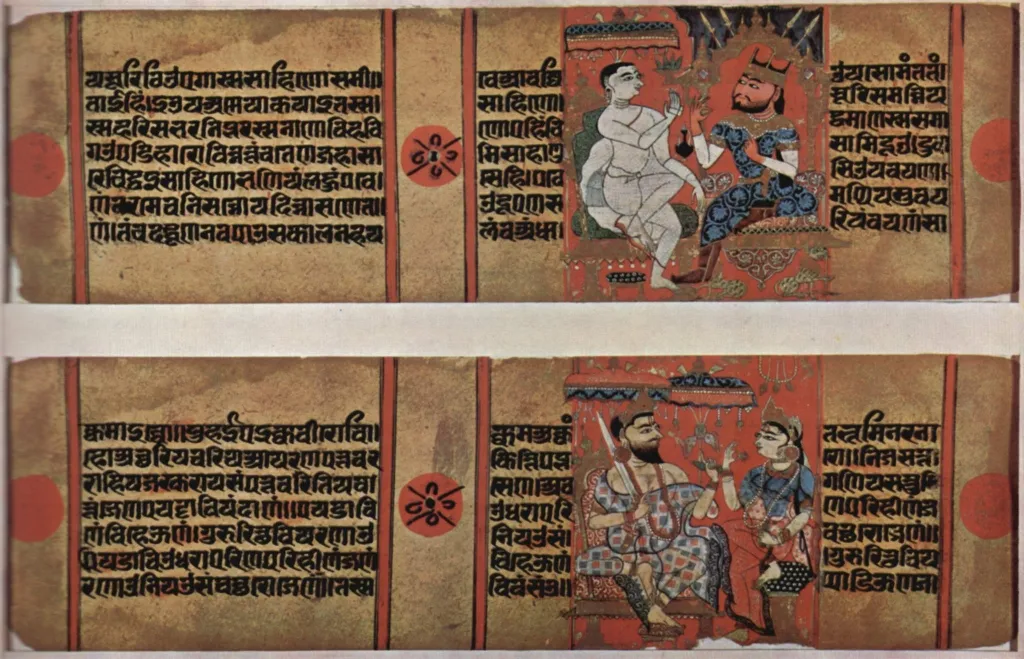
A well-known narrative regarding the origin of this era comes from the Kalakacharya Kathanaka, a text written by the Jain sage Mahesarasuri.
The story goes that Gandharvasena, the powerful king of Ujjain, abducted a nun named Sarasvati, who was the sister of the Jain monk Kalakacharya. The monk sought the assistance of the Śaka ruler, King Sahi. With their help, Kalakacharya defeated Gandharvasena and rescued his sister.
Later, Gandharvasena's son, Vikramaditya, marched on Ujjain, successfully drove out the Śaka forces, and established his reign. To mark this grand restoration and triumph, he commenced the Vikrama era.
Historical Development
Although popular culture attributes the calendar directly to King Vikramaditya, historical records and epigraphy tell a more gradual story. In early inscriptions (such as those from the 4th and 5th centuries CE), this era was known as the Kṛṭa or Malava era. It was only from the 9th century CE onward that the name "Vikrama Samvat" became popularized in administrative and literary records across the Indian subcontinent.
How Nepal Adopted B.S. as its Civil Standard
While the Vikram Samvat calendar originated in India, India primarily uses the Gregorian calendar for administration and the Saka calendar as its official national calendar. In India, Vikram Samvat is reserved mainly for calculating Hindu religious dates and festivals.
Nepal, however, did something unique: it adopted Bikram Sambat as its primary, official civil calendar.
Chandra Shumsher's Reforms (1901–1903 CE)
Before the turn of the 20th century, Nepal relied on a mix of local calendars, including the Nepal Sambat (a lunar calendar system) and traditional lunar-based tithis for official business.
Because lunar calendars are shifting (with months varying in length and an extra month added every few years), they created massive administrative headaches. For example, tax collection, land registration, and government accounting were highly unpredictable when dates did not line up consistently with the seasons.
To solve this, the Rana dynasty, under Prime Minister Chandra Shumsher, formalized and standardized the Bikram Sambat as the country's official administrative and civil calendar between 1901 and 1903 CE (1958–1960 VS).
Coexistence with Nepal Sambat
While B.S. became the administrative standard, other regional calendars remained culturally significant. Most notably, Nepal Sambat, which began in 879 CE, is deeply cherished by the Newar community. In 2007 CE, the Government of Nepal officially recognized Nepal Sambat as a national calendar alongside Bikram Sambat, honoring its historical and cultural importance.
Nepal vs. India: Solar vs. Lunisolar
One of the biggest scientific differences between the Bikram Sambat of Nepal and the Vikram Samvat of India is how they track time:
- Nepal (Solar Civil Calendar): To make the calendar reliable for daily governance, Nepal uses a solar version of Bikram Sambat. The length of each month is determined by the transit of the sun through the zodiac signs (Sankranti). Consequently, the year has a stable length of 365 days (occasionally 366 in leap years), and the months vary from 29 to 32 days based on astronomical calculations.
- India (Lunisolar Religious Calendar): India uses the traditional lunisolar version of Vikram Samvat. It tracks twelve lunar months (based on the cycles of the moon). Because a lunar year is only about 354 days long, an extra month—called Adhik Maas (or intercalary month)—is inserted roughly every three years to keep the calendar aligned with the natural seasons.
The 12 Months of Bikram Sambat
The solar calendar of Nepal is divided into twelve months, beginning with Baisakh in mid-April. Here is how they correspond to the Gregorian calendar:
| S.No | Bikram Sambat Month (Nepali / Sanskrit) | Approximate Gregorian Equivalent | Duration (Days) |
|---|---|---|---|
| 1 | Baisakh (वैशाख / Vaiśākha) | April – May | 30 / 31 |
| 2 | Jestha (जेठ / Jyēṣṭha) | May – June | 31 / 32 |
| 3 | Asar (असार / Āṣāḍha) | June – July | 31 / 32 |
| 4 | Shrawan (साउन / Śrāvaṇa) | July – August | 31 / 32 |
| 5 | Bhadra (भदौ / Bhādrapada) | August – September | 30 / 31 / 32 |
| 6 | Ashwin (असोज / Āśvin) | September – October | 30 / 31 |
| 7 | Kartik (कात्तिक / Kārtika) | October – November | 29 / 30 |
| 8 | Mangsir (मंसिर / Mārgaśīrṣa) | November – December | 29 / 30 |
| 9 | Paush (पुस / Pauṣa) | December – January | 29 / 30 |
| 10 | Magh (माघ / Māgha) | January – February | 29 / 30 |
| 11 | Falgun (फागुन / Phālguna) | February – March | 29 / 30 |
| 12 | Chaitra (चैत / Caitra) | March – April | 30 / 31 |
Conclusion
The Bikram Sambat calendar is a testament to the scientific sophistication of ancient South Asian astronomy. In Nepal, it serves as a powerful symbol of national sovereignty and cultural identity. While the rest of the world coordinates through the Gregorian calendar, Nepal stands proud with a system that remains harmonized with the movements of the sun and the rich tapestry of its cultural heritage.
So, the next time you look at a calendar in Nepal, remember: you aren’t just looking at a different set of numbers; you are experiencing a living tradition that is uniquely 57 years ahead.
Prepared by the Nepal Jyotish Team.