Kshaya SamvatsaraJupiter TransitPanchangNepali CalendarAstrology
The Lost Year: Why Nepal's Calendar Skipped 'Kalayukta' and How Jupiter's Speed Shapes Our Time
Explore the rare astronomical phenomenon of Kshaya Samvatsara (the Lost Year) in the Nepali calendar, why the year name Kalayukta vanished in 2081 BS, and how Jupiter's orbit coordinates our Panchang.
N
Nepal Jyotish TeamIf you looked closely at the official Nepali calendar (Panchang) for the year 2081 BS (which began on April 13, 2024), you might have noticed a puzzling discrepancy. In the traditional 60-year cycle of year names, a year seemed to have completely vanished.
In 2080 BS, the year was named Pingala (the 51st year of the cycle). Naturally, you would expect the year 2081 BS to be named Kalayukta (the 52nd year). Instead, the official calendars of Nepal jumped directly to Siddharthi (the 53rd year).
What happened to Kalayukta? Did the calendar committee make a mistake?
The answer lies in a rare, fascinating astronomical phenomenon known as Kshaya Samvatsara—literally, the "Lost Year." Let’s dive into the science of Jupiter’s orbit and how celestial acceleration occasionally swallows a year name from our calendar.
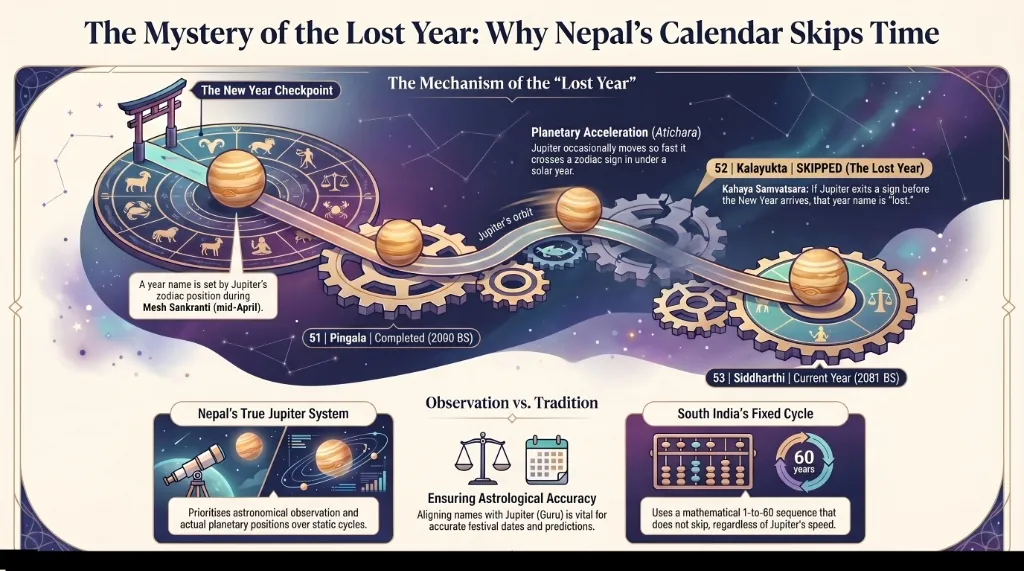
Understanding the 60-Year Samvatsara Cycle
In Vedic timekeeping, a year is not just a number; it has a name. The calendar cycles through a sequence of 60 distinct names, known as the Shashtyabda (60-year) cycle. Each name represents a Samvatsara (a Jovian year), which is determined by the movement of the planet Jupiter (Brihaspati).
Here are the names of the years surrounding the transition we experienced:
- 51. Pingala (Year of 2080 BS)
- 52. Kalayukta (The year we expected for 2081 BS)
- 53. Siddharthi (The year Nepal actually used for 2081 BS)
In most cycles, the naming proceeds in a simple chronological sequence. However, because the calendar is tied to the physical position of a planet in space, it must adjust when the planet's orbit changes speed.
The Science of Kshaya Samvatsara (The Lost Year)
To understand why a year name gets skipped, we have to look at how a Samvatsara is calculated in the Nepali astronomical system:
- Jupiter’s Transit: Jupiter takes approximately 11.86 Earth years to complete one orbit around the Sun. Because the zodiac is divided into 12 signs (Rashi), Jupiter spends roughly one year in each zodiac sign.
- The New Year Checkpoint: The name of the Samvatsara is determined by the exact position of Jupiter at the moment of Mesh Sankranti (the Solar New Year in mid-April, when the Sun enters Aries). Whichever zodiac sign Jupiter resides in at that precise moment defines the name of the incoming year.
- Jupiter’s Acceleration (Atichara): Because planetary orbits are elliptical and subject to gravitational influences, Jupiter does not move at a perfectly uniform speed. Occasionally, Jupiter enters a state of acceleration called Atichara. During this phase, it moves so fast that it crosses an entire zodiac sign in less than a solar year.
- The Skip Mechanism: If Jupiter enters a zodiac sign after one Solar New Year and exits it before the next Solar New Year, the Sun never crosses the Mesh Sankranti threshold while Jupiter is in that sign. Since there was no "New Year moment" to inaugurate it, that sign's corresponding year name—in this case, Kalayukta—never gets its turn. It is skipped, or "lost" (Kshaya).
In mid-2024 (2081 BS), Jupiter accelerated through the sector corresponding to Kalayukta so quickly that by the time the Solar New Year arrived, Jupiter had already crossed into the next sector, corresponding to Siddharthi. Thus, the calendar jumped directly from Pingala to Siddharthi.
Why Indian Calendars Didn't Skip the Year
This phenomenon created significant confusion because calendars in neighboring India did not show this jump. Why?
The discrepancy exists because of a difference in calendar systems:
- South India (Fixed Cycle): The southern parts of India use a simplified, mathematical Fixed Cycle for naming years. This system does not track the actual physical position of Jupiter in real-time. Instead, it follows a strict, unskipping 1-to-60 sequence. Therefore, they counted Kalayukta in their traditional calendar during this period.
- Nepal (True Jupiter Cycle): The official Nepali calendar, managed by the Nepal Panchanga Nirnayak Samiti, follows the True Jupiter (Spashta Brihaspati) system. This system prioritizes astronomical observation and actual planetary positions. Because Jupiter physically sped up in the sky, the calendar skipped the name to remain mathematically and astronomically accurate.
The Astrological Significance of Jupiter (Brihaspati)
In Vedic astrology, Jupiter is known as Guru—the teacher, the bringer of light, wisdom, and expansion. Because Jupiter’s transit through the zodiac governs the spiritual and energetic theme of the year, aligning the calendar name with Jupiter's actual physical position is considered vital for accurate astrological readings, festival alignments, and Panchang predictions.
By skipping the "lost" year name, the Nepali system ensures that the name of the year accurately reflects the cosmic energies of Jupiter's true position in the night sky.
Conclusion
The vanishing of the year "Kalayukta" is not a printing error, but a beautiful demonstration of the dynamic nature of the Nepali Panchanga. Unlike static calendars that drift away from cosmic reality, the Bikram Sambat and its astronomical naming system remain in constant conversation with the actual movements of the planets.
It reminds us that time is not just a human invention, but a reflection of the celestial dance happening above us.