Jwaladevi
Location
Jwaladevi
Jwaladevi Temple, located in the Sristhan, Nabhisthan, and Shiristhan areas of Dailekh district, is a unique and sacred religious site in Nepal. Here, a continuous blue and red flame can be seen burning from time immemorial due to natural gas emerging from underground. It is also known as the Panchakoshi pilgrimage site and the Vaishwanar region. Hindu devotees worship it as the manifestation of power.
History and Mythological Belief
Jwaladevi Temple falls under the famous Panchakoshi pilgrimage site of Dailekh. According to the religious texts Swasthani Vratakatha and Skanda Purana, various body parts of Sati Devi fell here while Lord Shiva was wandering carrying her dead body. It is believed that the head fell in Shiristhan, the navel in Nabhisthan, and the feet in Padukasthan. In the medieval period, the Khas Malla kings developed this region as a religious center.
Architecture
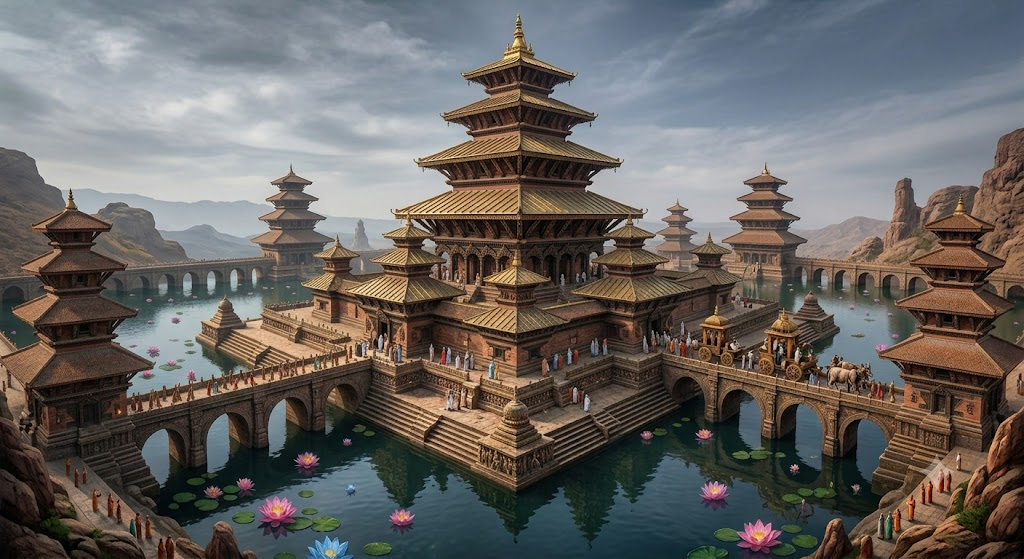
The temples here are based on the traditional Nepali pagoda style and stone architecture. Brick, wood, stone, and mud have been used in the construction of the temples. There are doors covered with copper plates and attractive brass pinnacles (gajur) at the entrance of the temple. Separate 'Dhuni houses' or pools have been made for the place where the flame burns.
Worship Method and Tradition
There is an ancient tradition of Yogis (saints) of the Nath sect performing worship in the temples of this region. Worship is performed here using Panchopachar and Shodashopachar methods. Moving around the five sacred sites of Dailekh (Shiristhan, Nabhisthan, Padukasthan, Dhuleshwar, and Kotila) is called the 'Panchakoshi Yatra', which is a popular belief to fulfill wishes. Since it is a Shakti Peetha, there is also a practice of sacrificing buffaloes and goats here.
Festivals and Fairs
- Bada Dashain and Chaite Dashain: A large fair is held during Navaratri and thousands of devotees come to offer sacrifices and worship.
- Mahashivaratri: Since it is a favorite place of Lord Shiva, special worship and fairs are held during Shivaratri.
- Maghe and Baisakhe Sankranti: On these days, there is a large crowd of people bathing and visiting the Panchakoshi area.
Scientific Importance
Along with religious faith, the flame here is scientifically considered a store of natural petroleum gas. Currently, petroleum exploration work is being done rapidly in this region in collaboration with the governments of Nepal and China.
Travel Guide: How to Reach
- By Air: Fly from Kathmandu to Nepalgunj Airport, then take a bus or hire a private jeep to Surkhet (approx. 2–3 hours). From Surkhet, continue by road to Dailekh Bazaar (approx. 5–6 hours).
- By Road: Direct buses are available from Kathmandu to Dailekh, though it is a long journey of about 18–22 hours.
- Local Transport: The main sacred sites of Shreesthan and Nabhisthan are located near Dullu, about 11–12 km from Dailekh Bazaar, and can be reached via local jeeps or taxis.
Best Time to Visit
- Spring (March to May) & Autumn (September to November): These are the peak seasons with clear weather and comfortable temperatures for exploring the hilly terrain.
- Festivals: Maha Shivaratri and Navratri are the most vibrant times for a spiritual experience.
- Avoid Monsoon: The rainy season (June to August) can make hilly roads slippery and difficult to travel.
Visitor Information & Tips
- Panchakoshi Pilgrimage: To complete the traditional pilgrimage, aim to visit all five sacred sites: Shreesthan, Nabhisthan, Padukasthan, Dhuleshwar, and Kotila.
- Eternal Flames: Be respectful of the natural gas flames; avoid touching them or throwing objects into the sacred pools.
- Dress Code & Etiquette: Wear modest clothing and remove shoes before entering the inner sanctums.
- Cash: Carry enough cash (NPR) as ATMs are limited outside Dailekh Bazaar and Surkhet.
- Accommodation: Basic to mid-range hotels are available in Dailekh Bazaar. For a local experience, look for community-based homestays.